
Quality by Design: Construction, Coordination, and Collaboration

Quality in design and construction is easy to recognize, but far more complex to achieve. It’s not just about how a building looks when it’s finished, but about the processes that carry a project from concept through construction. In this episode of Side of Design, we sit down with BWBR’s Director of Professional Services Dan Hottinger and Construction Administration Manager Bryan Desma to unpack what “quality” really means in design and construction—and how it begins long before a project breaks ground.

The Fundamentals of Quality

Dan works closely with construction administrators (CA), project managers, specifications writers, and code and quality assurance specialists in his role. “I like to joke that everything we do once we land the project to get it in the office, get it documented, out into the field, and built falls underneath my umbrella,” he says. For Dan, quality starts with the fundamentals: highly coordinated documents, strong alignment with engineering partners, and early, consistent attention to code and constructability. “With that, you know that everything is going to fit within the building. You know that everything is going to come together in the correct manner and you aren’t going to run into a whole bunch of problems out in the field.”

Bryan, whose role helps bridge the gap between designers and contractors to make sure design intent, budget, and schedule remain on track, expands the definition of quality beyond documentation. “There’s also the quality of our service—how we communicate, being responsive, providing solutions in a timely manner. We want to provide value in that respect too,” he says.

Construction Administration as Quality Assurance

It’s critical that quality is maintained through each step of the process—starting with design. “During the design process, we meet with our code officials and we talk through different code scenarios and make sure that the documentation reflects those discussions so that we don’t we don’t run into inspection problems as we go down the road,” Dan explains. “Our specified systems are ones that we know are proven—that they are good, that they are quality, and that they’re going to last for the client.”

The CA team helps protect that standard, making sure that the right conditions are met and the correct systems are installed. “We’re out there making sure that what’s in the drawings gets installed in the field, and we’re answering questions and bringing that vision to the actual built environment,” Bryan says.

Good documentation means a smooth handoff between the design and construction teams. “By the time you’re handing it off to construction administration, the better and more solid the set of documents, the easier it is for a person like Bryan to make sure that the owner comes away with a really good experience,” Dan explains. “It can save money because it’s smoother in the field, and we aren’t constantly having to go backwards and reassess certain details to see if we can make it work better.”

Learning from the Field

The conversation also explores how BWBR measures and improves quality over time. One key tool is the firm’s “report card” process, allowing QA and CA teams to flag issues in the design and process. “At the end of each project, a quality assurance reviewer will go in and log all of our problematic areas in that review,” Dan explains. “The construction administrators take the time to do a report card, and we use the same categories as we do for quality assurance reviews.”

That alignment allows BWBR to see recurring challenges and take a targeted approach to fixing them. “If QA is saying that we’re having hardware problems, Bryan’s teams out in the field are experiencing the same thing and they’re reporting to that to us,” Dan says. “Now we can put continuing education time into door hardware to make sure that this is something that we can teach up within the firm.”

The two share that BWBR employs a host of training and educational sessions where both emerging professionals and firm veterans can grow from colleagues’ specialized knowledge and lessons learned. Bryan also leads knowledge-sharing conversations geared specifically toward the CA group. “It’s a constant process, things are always changing. There’s always new technologies, and we always have new people coming in the office,” Bryan says. “It’s amazing how much investment that we have at this company with education, and it’s a big part of our culture.”

A Culture of Quality

The message is clear: quality doesn’t stem from just one process or role. It’s a continuous effort shaped by preparation, communication, education, and collaboration—and a major part of that is creating a culture that empowers teams to support one another in delivering their best work.

“One of the things that we try to engender at BWBR is just a culture where it’s okay to ask questions,” Dan says. “And also making sure that senior staff feel empowered to take the time to mentor. That right there is the foundation of your quality.”

Bryan highlights another critical—but often overlooked—dimension of quality: relationships. BWBR’s collaborative, solution-oriented approach with contractors and owners helps projects move forward more smoothly. “To get there, you have to invest in these relationships and have a certain amount of trust, and that takes time and it takes effort,” he says. “There’s quality within relationships, and that’s a big part of what we do as well.”

At BWBR, the goal is for quality to show up in every phase of a project—built through documentation, reinforced in the field, and sustained through education and trusted relationships that ultimately lead to better outcomes for clients and communities alike.

Side Notes: Integrating Sustainability, Quality, and Codes for Design Excellence

Sustainability, quality assurance (QA), building codes, and specifications—at BWBR, these critical design functions are overseen by Rachael Spires, Associate Principal and Performance Design & Quality Manager. In this episode of Side Notes, she explores how the seemingly distinctive roles intersect, all working together to drive design excellence in powerful ways.

Increasingly Interconnected

Although Rachael admits her job title is a mouthful, there’s a reason each of these roles go hand-in-hand. “The design world is moving towards integrated performance-driven design. Basically, let’s take all of these things and let’s mash them up,” she says. “We have sustainability and health and resilience and quality—and they’re not these separate checkboxes anymore.”

She explains that none of these items can stand alone. Building codes and performance design help to inform one another—while code is often seen as the minimum standard, increasingly rigorous sustainability commitments are helping to push requirements forward. The next piece is specifications, which is just as enmeshed. “There’s this growing understanding that specifications are where many of the firm’s commitments to performance and sustainability actually get implemented,” she says. Lastly QA, which ties all of the threads together by “making sure that the design intent and the firm sustainability goals hold true from documentation all the way through construction.”

While interconnected, each piece brings its own complexity and excitement as sustainability, accessibility, and quality evolve.

Performance in the Process

One thing that excites Rachael is BWBR’s own evolutions as a firm, including baking performance into each step of the design process. “This year we added a sustainability component to our QA process. So, all of our projects are getting reviewed in the DD QA and the CD QA with a sustainable lens,” she shares.

This means confirming that every project team completes the Common App (which is based on AIA’s Framework for Design Excellence), documents a facility’s Energy Use Intensity (EUI) or Lighting Power Density (LPD), and collects other critical data points around sustainability and accessibility. To begin each project on the right foot, a performance baseline meeting occurs at kick off to keep sustainability in mind from day one of design.

Rachael shares that this is just the starting point, laying the groundwork for expanding sustainable project reviews. “In the future, I could see us reviewing things for materiality, daylighting, carbon, embodied carbon, and operational carbon,” she says.  She compares the process to building a muscle—BWBR’s sustainability muscle, that is: “The more we work it, the better that everyone in the office is going to get at using that muscle and making it stronger and stronger. And our projects are just going to get better and better.”

Sustainable Solutions

When looking at the challenges of integrating sustainable design into projects, Rachael says two issues consistently come up: budget and schedule. Luckily, by having sustainability embedded in the project from the beginning, “we’re able to create a design that is better—hopefully without adding cost and taking extra time. That’s our goal.”

Problem solving is Rachael’s favorite aspect of design, which comes in handy when navigating those constraints. “Everything around us is because a problem existed and someone designed a solution,” she says. “For me, the most rewarding part is being able to connect these big picture sustainability goals and resilience with the technical details.”

And to help achieve performance design goals even more efficiently in the future, the team is currently completing sustainable materials research. This data informs the products in BWBR’s Office Master Specifications—a guide that steers material selection on firm-wide projects. “We can look at product A and product B. If product B has many more sustainable properties than product A does and the cost difference is negligible, let’s go ahead and put product B in. And now we just elevated that project,” she explains.

Growing Greener Together

Rachael describes a shift happening in sustainability conversations “from just trying not to do bad to actually doing regenerative outcomes and making our projects give back.”

The next generation of design leaders will play a key role in progressing these goals, and that’s exactly what inspires Rachael as she looks ahead to the future. “I love watching someone gain confidence as they master a new concept or apply sustainability or codes or specifications in a new way,” she says. “It’s so great to see the next generation take that initiative, learn something new. Now they understand a concept that they can take with them for the rest of their life.”

With five newly LEED-accredited professionals at the firm in 2025 year and two more currently taking tests, the future of sustainable design looks bright at BWBR.

Built for Community: Five Years of Impact at Regions Hospital Birth Center

What does it take to create a birth center that truly serves its community—clinically, culturally, and emotionally? The Regions Hospital Birth Center was designed with this question in mind, taking a family-centered approach that integrates the latest care choices with the multicultural needs of mothers in the Twin Cities. In this episode of Side of Design, we take a deep dive into the design process as the hospital celebrates five years of impact.

Joining the discussion are Rochelle Johnson, Vice President of Patient Care and Chief Nursing Officer at Regions Hospital, along with BWBR project team members—Principal Melanie Baumhover, who served as Project Manager, Principal Mike Boldenow, and Senior Healthcare Planner Sophia Skemp. The conversation explores the project’s vision, challenges, and—most importantly—how the birth center continues to transform care.

A Commitment to Care

When early conversations about the Birth Center began, the hospital was at a crossroads. With declining birth rates and an outdated facility, leaders at Regions faced a choice: “If we’re going to do this, we’re going to do it right,” Mike explains, “and if we’re not, we might take a step back and not do OB and birthing at Regions at all.”

Walking away would have meant leaving behind downtown Saint Paul, a diverse, urban city that relied on the hospital for accessible care close to home. Leadership chose to invest in the community, with a goal of becoming the chosen site for care across the greater East Metro.

“Women choose the facility they want to deliver in, and the environment makes a big difference,” Rochelle explains. A high-quality facility with thoughtfully planned rooms, progressive care models, and appealing amenities would help drive Regions to the top of the list for expecting families. “And in our case, being a facility that’s in the middle of the city, we also had to think about how we deliver care to ethnically diverse communities in a way that would make them choose us.”

Rochelle joined the organization just as that commitment was being made. “It was a unique opportunity for me as a new leader in an organization who had a dream about something different,” she says—a dream for a new facility that would be grounded in equity, family, and clinical excellence.

Creating a Shared Vision

Sophia compares a birth center to a “mini hospital within a hospital,” with just as many departments within one facility. “So how do we make sure it is an inclusive design process with so many players?” she asks.

Representation was critical, giving each department a seat at the table to provide feedback—not only during design meetings but also during facility tours and when viewing mock-ups. “It creates an environment of understanding, inclusivity, and a design that’s going to hopefully work for everyone,” Sophia says. Melanie shares that healthcare teams even ran scenarios in full-scale mockup rooms, leading to important discoveries to get spaces right for staff workflows.

With close to 400 clinical staff and provider groups and 75 rooms within the building, there were diverse opinions coupled with a need for continuity between spaces. “It was my job to say, what is our shared vision for what this space is actually going to look like?” Rochelle says. “And we had lots of conversations around what was important to not only our clinicians and our staff, but also the community that we served.”

Community Comes First

Rochelle says that the vision the team landed on five years ago is still shared with new staff members today. “It’s a place where we deliver high reliability, it’s family-centered, and it’s focused on healthcare equity.” This is particularly important in a hospital where “60% of our patients are people of color, 25% of them need an interpreter for their care, and more than 60% of them use some type of government program to pay for their care.”

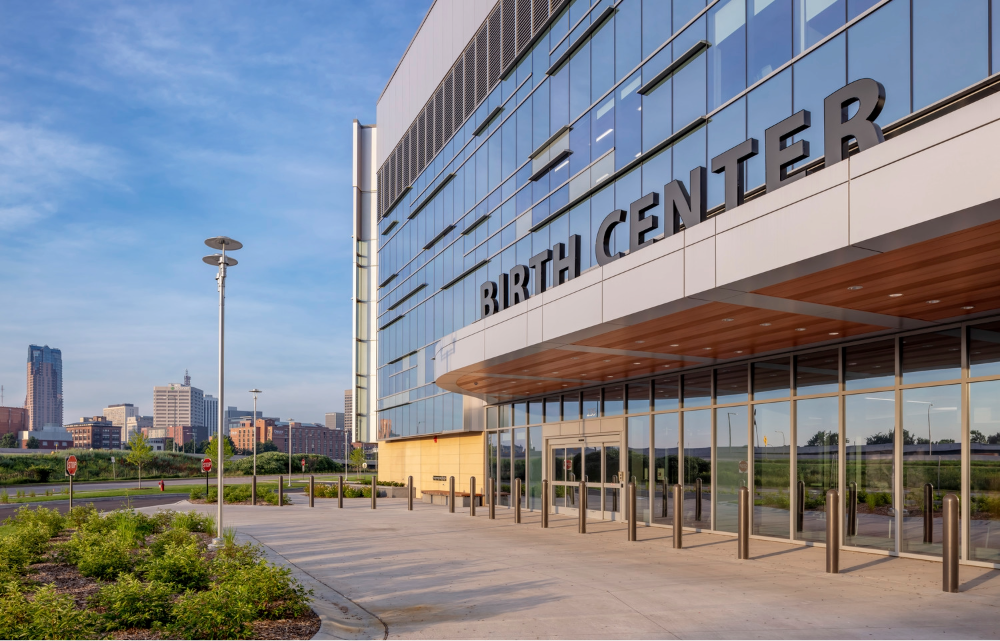
With large healthcare disparities impacting this population, it was crucial to create a truly comfortable and welcoming facility. “We made some intentional decisions to make it more of a hospitality-based service and building,” Mike explains. “It has its own dedicated patient and family entrance, separate from the main hospital on the other side of the campus, to make it feel special. You come into a very hospitality-driven lobby, and then even in the patient care spaces themselves.”

Rochelle’s partners and predecessors at Regions had built many community partnerships over the years. “We had the unique opportunity to go out to those community partners and ask our Hmong community, what would you want to see in a birth center?” she says. “We are part of an organization within the Twin Cities called the Birth Equity Community Council, and we brought topics there for the black community to learn what have traditionally been barriers to them feeling comfortable in the spaces we provide.” 

From bringing a traditional Hmong post-pregnancy soup to the hospital’s kitchens—working with the University of Minnesota and Regions’ nutrition services teams to grow the required herbs—to integrating artwork and imagery reflective of diverse communities, the goal was to create a hospital where every family would feel at home.

Quality Care, Thoughtfully Designed

To provide the highest quality of care, the team needed to utilize strategic healthcare design and progressive care models that would set the Regions Hospital Birth Center apart.

“Regions had the first couplet care in the state of Minnesota,” Melanie shares. As a mother who was separated from her own premature baby after birth, the inclusion of this care model hit home for her. “He was born, they brought him straight to the nursery, and I had to stay in bed. It was so emotional. So, when our consultant brought the idea of couplet care, where both the newborn and the mom are cared for in the same room, it was just so touching for me.” Rochelle says that in their first year, they were able to keep approximately 200 babies and mothers together who would otherwise be separated without couplet care design.

The design team shares that thoughtful design and amenities extended to every corner of the hospital—from hotel-inspired bathrooms and birthing tubs to comforting aesthetics in the operating room since most patients are awake for C-sections. And as Melanie adds, the hospitality extends to staff spaces too. “We have our staff break rooms on the outside wall with access to gorgeous daylight, which doesn’t always happen, and then access to the new courtyard that was developed as part of the building as well.”

Five Years of Impact

Five years after opening, the Birth Center has exceeded expectations: a projected 30% growth in births by 2025 was achieved, adverse outcomes related to postpartum hemorrhage dropped by 21%, and families across the risk spectrum receive care tailored to their needs. “Women’s lives are saved at Regions Hospital,” Rochelle says.

Looking back, the group agrees on what made the difference: start with a clear vision, build inclusive processes early, and bring people together—physically—around shared goals. “These projects only work when the guiding principles are clear,” Mike says. “They keep everyone aligned when decisions get hard.”

“Having the BWBR team come in and just be super ears open, listening to that passion that the clinicians and the staff had for the care that we provide to families was really important. And it made something that is actually serving the community in the way that they need,” Rochelle shares.

Together, the strong vision and collective teamwork transformed the Birth Center into more than a successful facility—creating an environment where compassion, community, and care come together to serve families for years to come.