

When Upland Hills Health’s existing facilities—some dating back to the late 1800s—could no longer keep pace with patient needs, the Dodgeville, Wisconsin-based health system partnered with BWBR to reshape rural health in their communities. What started with a clinic relocation in 2023 has since developed into a full master facility plan, guiding strategic growth for the organization.
In this episode, we dive into the partnership between the healthcare system and BWBR. Joining us from Upland Hills Health are Mark Thompson, President and CEO, and Ryan Teasdale, Director of Facilities. From BWBR are Principal Mike Boldenow, Senior Project Manager Andrea Cecelia, and Healthcare Innovation and Operations Strategist Jessica Sweeney. Together, they unpack what makes rural healthcare design different and how they’re working together to create community-centered, future-ready facilities.
Growing a Rural Healthcare Destination
Upland Hills Health is an integrated, community-minded health system with a 25-bed hospital and seven ambulatory clinics—six of which are credentialed as rural health centers. As the sole hospital in Iowa County, the organization serves approximately 40,000 people overall, with 15,000 emergency department visits and about 200 deliveries a year.
With their location just outside of the Madison metro market, the organization serves a diverse population, including many patients who work in the urban Madison area while living in rural communities. “We’re on the border of whether patients are deciding to travel to the big city or whether they want to stay here,” explains Ryan. The same challenge extends to staff. “Having been here as long as I have, I’ve seen the struggles of being able to acquire and retain good staff, because people have historically driven to Madison for higher wages or different jobs.”
Bringing advanced programs and high-quality care close to home helps ease that choice—an advanced robotics program is one of the ways UHH is enhancing innovation, with surgical technology including a micro-robot and a Da Vinci robot in their hospital. “We’ve been able to gain a lot of ground in retaining staff with the growth and the number of patients that we that we’re seeing and the services we’re providing. It’s all slowly growing,” Ryan says.
“We’ve grown our footprint and we’ve invested in specialty services and access that you don’t always see in a rural health system,” says Mark. “Our work with BWBR and designing, implementing, and creating exceptional experience and culture through physical design and workplace and our rural health clinics has been a very important part of our strategy.”
Designing for Change
Flexibility is one of the biggest drivers for rural health systems, allowing organizations to adapt to change, maximize space, and remain future-ready. “Everything is being designed in a manner that if things change, we have the ability to adapt and change,” says Ryan.
“From our perspective, when we’re thinking about utilization and looking at that data piece, the last thing we want to do is design or plan for spaces that aren’t being used,” says Jessica. By designing spaces that can flex between different specialties day-to-day, “we can use that space every day versus just one day a week,” she explains.
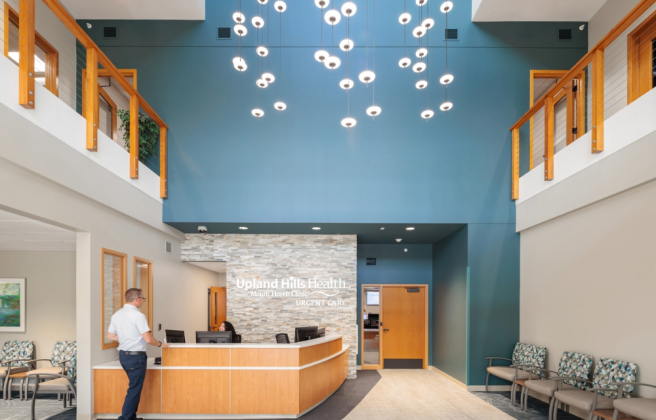
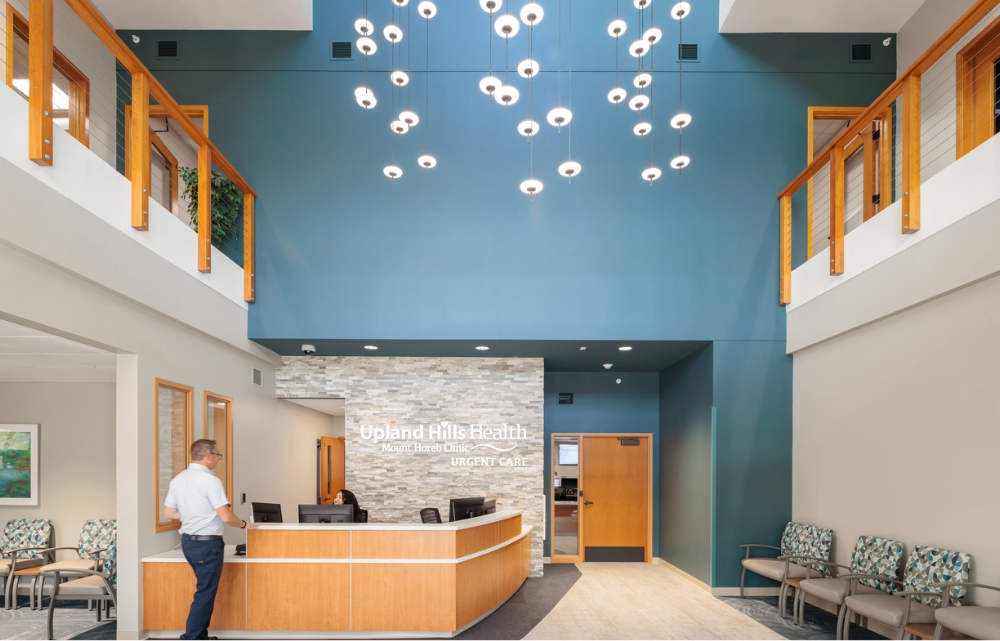
The latest projects at Upland Hills Health clinics have demonstrated this in action. “A great example is the Mount Horeb clinic project that we worked on together. Part of the design was to include both clinic and urgent care and allow them to flex,” Andrea shares. Since the clinic and urgent care have different peak times and off hours, they were able to share facilities and maximize space, with the urgent care utilizing clinic areas after the clinic closes.
Standardizing Across Specialties
Sometimes, flexibility doesn’t just mean change—instead, it means consistency across environments. As Mike explains, “From the first clinic renovation we did, we started trying to develop standards. Standards then translate into flexibility because you can easily go from one specialty to another, whether it’s just day-to-day or if it’s next year when you change your mix of providers.”
“We have a small number of specialists that as we design our clinics, we’re thinking more about outreach in our organization,” Mark adds. “So, we’re exploring opportunities like hoteling from site to site.” By designing care environments in a standardized way between locations, staff can easily and quickly adapt to each workspace.
Beyond patient rooms, the standardization of clinic modules and operational models creates enhanced efficiency and consistency across locations, using successful concepts from previous clinic projects. “As you implement those standards, it helps inform processes which means people benefit from it every single day,” says Mark.
Partnership as Foundation
The journey to partnership between Upland Hills Health and BWBR began with growth pressures that indicated a need for strategic change. “We were under pressure from existing buildings not meeting the needs because they were old. They were outdated. They were built in the late 1800s. So, it was really a start for us—we knew that we needed to do something different,” says Ryan.
BWBR’s selection was influenced by a critical factor: communication. “I remember from the interview saying the word communication multiple times,” Andrea says. This emphasis on open dialogue became the foundation of their collaboration. What emerged from those early conversations was a pivotal shift in thinking—rather than solving immediate needs reactively, the team stepped back to envision a comprehensive strategy for growth.
“We had a lot of needs, and with those needs, you got to organize them,” explains Ryan. “Otherwise, you’re scattershot and you’re not prepared for the future.” The master facility plan that followed addressed these needs, all considered within a cohesive framework rather than as isolated projects.
The strategic plan paid dividends in clear growth. Mark points to the five-year metrics: “We looked at the last five years, and this was a mixed effort because there’s some acquisitions that had occurred, but we saw a 36% increase in unique primary care patients over a five-year period, which is just tremendous.” This increase reflects not just expansion, but the resonance of a community-centered approach to care delivery.
Community Character, Unified Brand
As Upland Hills Health expanded across multiple communities, a new design challenge emerged: how to maintain a unified organizational identity while respecting the distinct character of each area served. “We have many communities, and when I think of the differences between each of those communities, you need to treat them as individual spaces,” says Ryan.
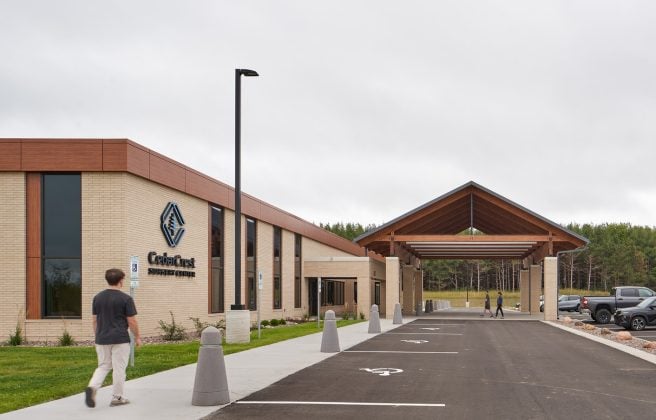
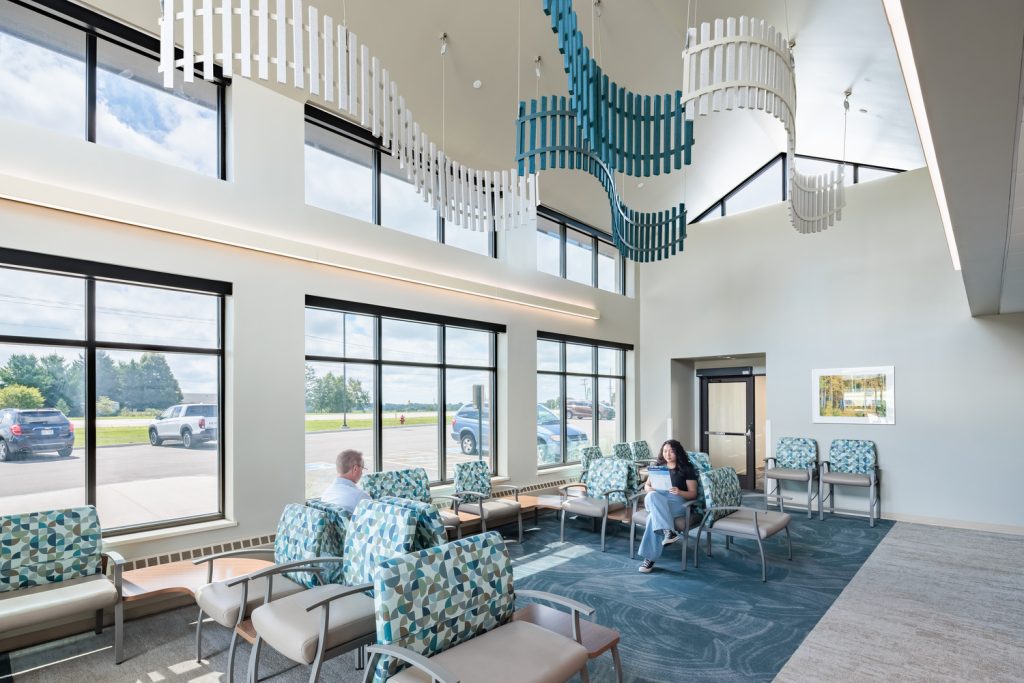
The approach reflected deep respect for local pride. When designing the Mineral Point and Mount Horeb clinics, the team intentionally chose different aesthetic directions. Mineral Point drew from its historic downtown character, while Mount Horeb embraced a modern prairie style.
“You very easily could have designed two identical clinics looking exactly the same,” Andrea says, “instead it was about the community those clinics were in, even though they were what is it, 30 miles apart, give or take, and really expressing that community in and of itself.” Despite these thoughtful differences, the interiors maintain subtle connections—shared light fixtures, coordinated color palettes—that unify the system-wide brand.
Jessica emphasizes the deeper impact of this commitment: “One of the things we know with rural health is the success of the organization contributes to the success of the community. When we help you all, when you all are successful, the community itself is successful. There’s a huge correlation there.”
Looking to the Future
As Upland Hills Health continues to build and evolve, Ryan draws on experience from the three master facility plans across his 16-year tenure: “Once you’re on the right course and once you have a good partnership—as we do—the thing I’ve learned the most about this process is really trying to see things from a much larger picture. If you don’t do that, you’re short-sighting your projects, you’re short-sighting your planning.”
The plan, the team emphasizes, must remain a living document—regularly revisited and adapted as conditions shift. Mike reinforces this: “It’s always good to go back and revisit that master plan every year, two to three years, because we know things are going to be different. If they’re done right, strategic master plans are more than just a site plan with colored blocks on them. Technology infrastructure, provider type strategies, community demographics—everything comes into play.”
“If you don’t do that, you’re going to be reacting all the time instead of being proactive,” Ryan says.
Upland Hills Health’s growth demonstrates what’s possible when organizations move beyond reactive problem-solving to embrace strategic vision. By combining thoughtful facility design, operational flexibility, and care for each community’s unique character, they’re building a model for rural healthcare systems to innovate, attract talent, expand services, and bring high-quality care closer to home.