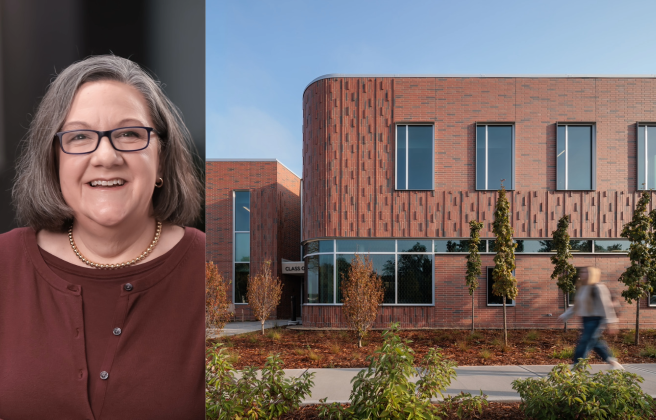



Sustainability, quality assurance (QA), building codes, and specifications—at BWBR, these critical design functions are overseen by Rachael Spires, Associate Principal and Performance Design & Quality Manager. In this episode of Side Notes, she explores how the seemingly distinctive roles intersect, all working together to drive design excellence in powerful ways.
Increasingly Interconnected
Although Rachael admits her job title is a mouthful, there’s a reason each of these roles go hand-in-hand. “The design world is moving towards integrated performance-driven design. Basically, let’s take all of these things and let’s mash them up,” she says. “We have sustainability and health and resilience and quality—and they’re not these separate checkboxes anymore.”
She explains that none of these items can stand alone. Building codes and performance design help to inform one another—while code is often seen as the minimum standard, increasingly rigorous sustainability commitments are helping to push requirements forward. The next piece is specifications, which is just as enmeshed. “There’s this growing understanding that specifications are where many of the firm’s commitments to performance and sustainability actually get implemented,” she says. Lastly QA, which ties all of the threads together by “making sure that the design intent and the firm sustainability goals hold true from documentation all the way through construction.”
While interconnected, each piece brings its own complexity and excitement as sustainability, accessibility, and quality evolve.
Performance in the Process
One thing that excites Rachael is BWBR’s own evolutions as a firm, including baking performance into each step of the design process. “This year we added a sustainability component to our QA process. So, all of our projects are getting reviewed in the DD QA and the CD QA with a sustainable lens,” she shares.
This means confirming that every project team completes the Common App (which is based on AIA’s Framework for Design Excellence), documents a facility’s Energy Use Intensity (EUI) or Lighting Power Density (LPD), and collects other critical data points around sustainability and accessibility. To begin each project on the right foot, a performance baseline meeting occurs at kick off to keep sustainability in mind from day one of design.
Rachael shares that this is just the starting point, laying the groundwork for expanding sustainable project reviews. “In the future, I could see us reviewing things for materiality, daylighting, carbon, embodied carbon, and operational carbon,” she says. She compares the process to building a muscle—BWBR’s sustainability muscle, that is: “The more we work it, the better that everyone in the office is going to get at using that muscle and making it stronger and stronger. And our projects are just going to get better and better.”
Sustainable Solutions
When looking at the challenges of integrating sustainable design into projects, Rachael says two issues consistently come up: budget and schedule. Luckily, by having sustainability embedded in the project from the beginning, “we’re able to create a design that is better—hopefully without adding cost and taking extra time. That’s our goal.”
Problem solving is Rachael’s favorite aspect of design, which comes in handy when navigating those constraints. “Everything around us is because a problem existed and someone designed a solution,” she says. “For me, the most rewarding part is being able to connect these big picture sustainability goals and resilience with the technical details.”
And to help achieve performance design goals even more efficiently in the future, the team is currently completing sustainable materials research. This data informs the products in BWBR’s Office Master Specifications—a guide that steers material selection on firm-wide projects. “We can look at product A and product B. If product B has many more sustainable properties than product A does and the cost difference is negligible, let’s go ahead and put product B in. And now we just elevated that project,” she explains.
Growing Greener Together
Rachael describes a shift happening in sustainability conversations “from just trying not to do bad to actually doing regenerative outcomes and making our projects give back.”
The next generation of design leaders will play a key role in progressing these goals, and that’s exactly what inspires Rachael as she looks ahead to the future. “I love watching someone gain confidence as they master a new concept or apply sustainability or codes or specifications in a new way,” she says. “It’s so great to see the next generation take that initiative, learn something new. Now they understand a concept that they can take with them for the rest of their life.”
With five newly LEED-accredited professionals at the firm in 2025 year and two more currently taking tests, the future of sustainable design looks bright at BWBR.