
Idea
Cloud

Listing all articles within the Architecture category.

What Can 4th Graders Teach Us about Designing for Health

The questions from a fourth-grade student at St. Gabriel's Elementary School give BWBR's principal designer Jim Davy, AIA, an opportunity to see hospitals through different eyes.

What would you put in a hospital to entice people to come there?

What would your hospital look like that would make you say, “That’s awesome!”?

How would you design your hospital to make it comfortable and nice?

If you could go to the hospital for something more than being sick or injured, what would you go there to do?

Think about those questions for a moment. Ask most adults about hospitals, their minds will immediately jump to being sick, injured, sitting in sterile environments, and costs.

But, what if we could start from scratch and not think of hospitals as places where care services are delivered but as places where health is promoted?

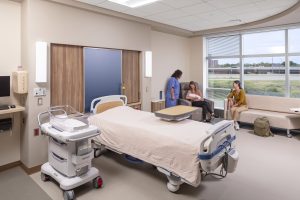
That was a bit of the idea prompting us recently to visit the fourth grade class at St. Gabriel’s Elementary School in Prairie du Chien, Wis. It’s not that we were out of ideas, or that we couldn’t maybe think of some answers ourselves as we began to plan the new Prairie du Chien Memorial Hospital.

However, in answering those questions as adults, we often bring our experiences and prejudices to the discussion. What will this cost? Will the community think this is frivolous? No one goes to a hospital for THAT! What we wanted to explore was the idea that if we could elude these biases and previous experiences, what could we envision with no limitations?

Windows with flower boxes. Skylights and waterfalls. Colors. Desks for homework and tables for board games. A gym for exercise. Solar panels and windmills. Healthy food. Gardens with ponds. Giant teddy bears. A mowed lawn. Tube slide. A big sign that tells the community, “We love you.” Moving lights at night. Fish tanks. A place for animals. Green Bay Packers’ colors. (Hey, it is Wisconsin. Just think of the sponsorship possibilities!)

OK, maybe the Packers’ colors might be a little out there (where would Bears and Vikings fans go?).

What their answers showed us, though, is that a place for health to fourth graders is not all about doctors and nurses and hospital beds. Get beyond how we deliver care services, and you can see in these fourth graders’ comments that there are many opportunities for a hospital to engage people in being healthy. Many of these ideas even reflect strategies we have already adopted in other care facilities in recent years – facilities where people have asked us to think beyond care service delivery.

For many small rural communities that have a hospital, the chance to create a replacement hospital comes around maybe once in most people’s lives. Always taking a sober and mature view to creating a new facility, cost and safety rise to the forefront of issues. That’s reality, and being an adult.

We live in an exciting time, though, when we are redefining what it means to be healthy and have health care. To see this revolution through the eyes of a child who is not burden by past experiences, we can create a health center that is a resource for living, not simply a resource for care and rehabilitation. Afterall, what we create today is what we pass on to these fourth graders tomorrow.


Now Here’s the Way to Break Ground on a New Facility

BWBR's CEO Steve Patrick gets a different point of view during the groundbreaking for the Minnesota Army National Guard Field Maintenance Shop.

The shovel can be so cliché.

OK. The shovel was used. Admittedly, it’s hard to dig from the perch of a turret. But, the view is kind of cool, especially for those of us who don’t get to sit in one of these very often.

On Tuesday, the Minnesota Army National Guard broke ground on its new Field Maintenance Shop at the Arden Hills Army Training Site (AHATS) in Arden Hills, Minn. The new 109,000 s.f. operations building will provide needed upgrades to the maintenance work spaces and administrative offices, storage areas and support spaces in one state-of-the-art facility. It is a major component in the development of the AHATS as a premier Army and National Guard training site.

As a state-of-the-art building, it is designed for its technical use as a vehicle maintenance facility for the Guard’s tanks, troop carriers, trucks, humvees, and radar equipment; and it is expected to exceed the Guard’s mandate for achieving LEED-NC Silver Certification for energy use and sustainable design.

When you examine what the National Guard is doing nationally, the pursuit of LEED is significant and could provide a model for other guard units developing new campuses. Using the Xcel Energy’s Enhanced Design Assistance program, extensive energy modeling and analysis has been conducted to guide the design of daylighting systems, efficiency of the building shell, and selection of energy efficient resources. Models indicate the building will achieve 43% energy savings better than code guidelines.

Additive bid items have been incorporated for alternative energy systems – solar thermal, photovoltaic, and future connection to a potential geothermal system.

The campus also stands out for its location in a growing suburban community. Campus aesthetics will help the campus fit in with surrounding residential neighborhoods, and, to that end, the design of the building complements surrounding buildings, including the Grow the Army Readiness Center and neighboring Ramsey County/City of Arden Hills Public Works Facility.

Construction is expected to be complete in 2012.

In modern times, heritage matters

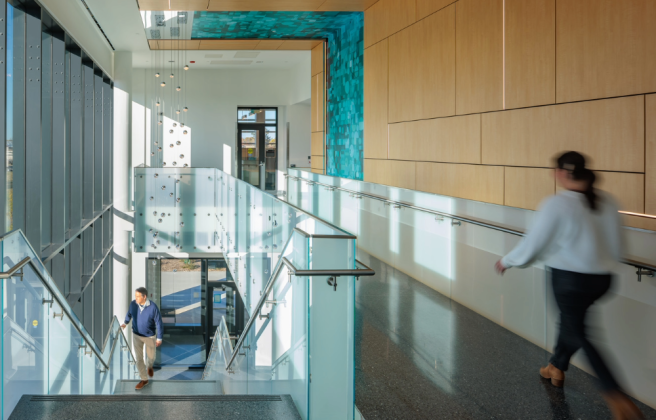
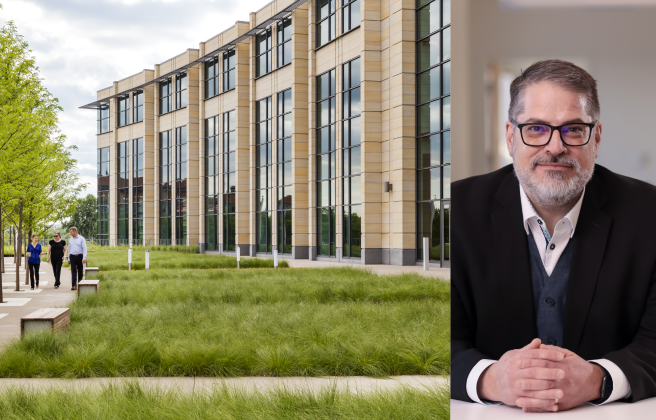
The atrium inside Beck Hall captures the simplicity and quality that characterizes both the Scandinavian and Lutheran heritage that is the foundation for Gustavus Adolphus College.

It was a celebration of 150 years of academic excellence, Lutheran values, and Scandinavian tradition.

And it was in a new academic center, the first on the college campus in 20 years.

The Warren and Donna Beck Academic Center at Gustavus Adolphus College in St. Peter, Minn., played host recently to the college’s sesquicentennial activities during its homecoming. The facility is everything that an academic facility at a highly respected liberal arts college should be: an asset to the campus, an inspiration for teaching and learning, a showcase gallery of the college’s creativity and talent, a symbol of the strength of the Gustie community both young and old, and a demonstration of the importance of stewardship.

It is also an expression of the honesty, simplicity, and quality that defines the Scandinavian heritage of the college rooted in Lutheran principles.

In an age defined by technological advances, it is easy to be tempted by the attraction of technology to engage people in academia, especially in a facility where labs encourage research and examination.

To design with simplicity and restraint, though, allows space to open people’s minds to creativity, collaboration, and exploration. Rather than letting the space define us and our actions with the tools of the moment, the students and teachers are free to define the space as their needs evolve, lending a timeless quality to academic study.

For a college celebrating its 150th anniversary, giving respect to its past is important. Finding inspiration in its heritage to chart its future, though, is what will motivate the Gustie community to – in the college’s words – make their lives count.

And, So It Begins

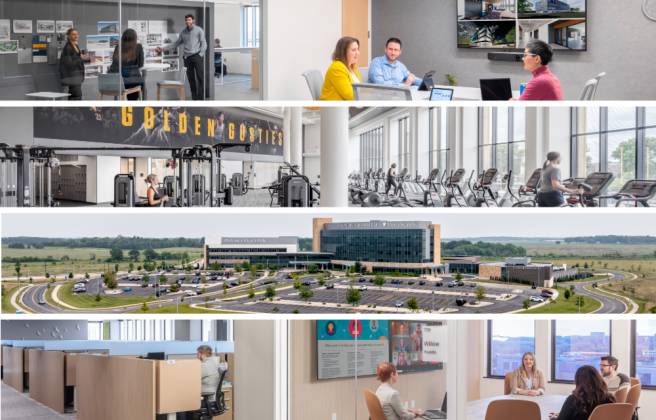
Construction begins on the refresh of BWBR's offices

Nearly 90 years. Amazing projects for large and small organizations. Lots of creative and innovative ideas. Now, it’s time to turn the mirror on us.

We’re going through a refresh. Nothing drastic, and for those who know us, no need to fret … the stone wall is staying. (But, do we have a deal on some decorative wheat grass!!!) Now we get to see if we make as good a client as we do a consultant.

Stay tuned.

Creating a Health Care Experience by Learning from Consumers

What does health care look like, both in a consumer setting and in a consumer-driven economy?

It is not a question seeking a definitive answer. Rather, it is a solicitation to the consumer to help shape their health care experience.

This is the premise of Mayo Clinic’s step into the ultimate consumer experience, the Mall of America. And it is the word “œexperience” that takes center stage in Mayo’s new presence, Create Your Mayo Clinic Health Experience.

Part store, part clinic, part social laboratory, there is nothing like Mayo’s effort in the nation, possibly the world. It is an experiment, an invitation to the general public to influence the future of health care. While health care traditionally has been a reactive practice, Mayo is changing the model with its presence at the Mall of America, empower and motivating people to take ownership of their health and change the course of health care.

To say that this has been an exciting project is a bit of an understatement. We live in a revolutionary time for health care. The changes that have occurred in clinical, ambulatory, and tertiary care have improved both the quality of care and quality of the work environment for patients and staff, respectively.

As wellness becomes more of a part of the definition of health care, how we define health care delivery must evolve. This challenges us to think differently, both in the creation of the space and the siting of that space. As consumers, it’s our duty to own our health and wellness. Mayo Clinic’s experiment is opening the door for us to take that ownership.

Check out this interview with the Mayo Clinic Administrator Jim Yolch. And, if at the Mall of America, stop by the Create Your Mayo Clinic Health Experience. Mayo wants to know how you define health and wellness.

Installing 18-ton magnet in underground laboratory

Check out this video of the installation of the magnets for the underground nuclear magnetic resonance laboratory at the University of Minnesota Academic Health Center. Just like it was designed to work. The Academic Health Center has also posted a slide show of the installation.

Moving Day for 20 Tons of Magnets at the University of Minnesota

It’s not just the students who are rushing to find new housing before classes start at the University of Minnesota. It’s taking a lot of “œfriends” to help move the massive magnets used in the Nuclear Magnetic Resonance laboratory at the U. Let’s hope those friends are treated to some Summit after the move. Check out the news story about moving 20 tons of magnets at University of Minnesota. (We take no responsibility for the pun made by the reporter.)

‘The finest science building in the UW system.’

West Lounge at Jarvis Hall

OK. Permit us a little latitude here to gush. We didn’t say it. And, it wasn’t told to us. But we’re pretty proud to know that the space we worked with faculty at University of Wisconsin ““ Stout to create functions so well.

When you think of a university science building, it has to do more than provide a space for learning. It has to accommodate experimentation. It has to facilitate research. Most importantly, it has to support community — those who work and learn and collaborate inside the space, and those who live, study, and work around the space.

Check out the tour colleagues from a nearby Gustavus Adolphus College received of the new academic science space.

Breaking the stigma of mental health through architecture

If we could wave a magic wand, how would we change the way mental health care is perceived?

This year marks the fifth anniversary for Avera Behavioral Health Center in Sioux Falls, S.D. Conceived at a time when most health organizations were putting investment in other health care strategies, Avera McKennan Hospital dared to ask the question, “œIf we could change the image of mental health care, what would we do?”

It’s a daunting question. Even with changes in federal regulations seeking parity in reimbursements for mental health care and physical health care, the business case has been challenging. Beyond the financial issues lay the social issues: tangible results are difficult to measure, and there is a stigma attached to people suffering from mental health illnesses.

Past building practices have made it easy to stigmatize mental health illness and treatment: less-than-prime space, separated facilities, or space behind locked doors in larger facilities. The segregation—even if meant to protect patient safety and privacy—reinforces the notion that mental illness is something to fear or to feel shame suffering.

Putting the treatment of mental illness prominently in the community changes the conversations about the illness. Brock Nelson, chief executive officer and president of Regions Hospital in Saint Paul, has noted that his organization’s new eight-story mental health care facility demonstrates that the level of care to be provide for mental health will be equal to the level of care provided for other illnesses. Design solutions in a facility such as Avera Behavioral Health show how space can transform both the delivery of and attitudes toward mental health care.

The National Alliance on Mental Illness has launched a campaign called “œFight Stigma” to battle the prejudice against and public depiction of people suffering from mental illness. Their advocates’ efforts are designed to respond to irresponsible depictions of mental illness.

But fighting the stigma doesn’t stop with mobilization of forces. The success of Avera Behavioral Health Center and the investment by Regions Hospital and Gundersen Clinic in LaCrosse, Wis., demonstrate that we can make a statement through buildings and spaces that people suffering from mental illness will be treated with the same dignity and respect as other patients.

The link between our physical well-being and mental well-being is irrefutable. No longer can we afford to ignore those links and treat mental health with less vigilance as we treat other illnesses. If we can influence the health and healing of patients in care settings, our efforts should be applied equally in mental health care facilities.